programData Science & AI/MLbeginnerFeatured

Data Science & AI Bootcamp

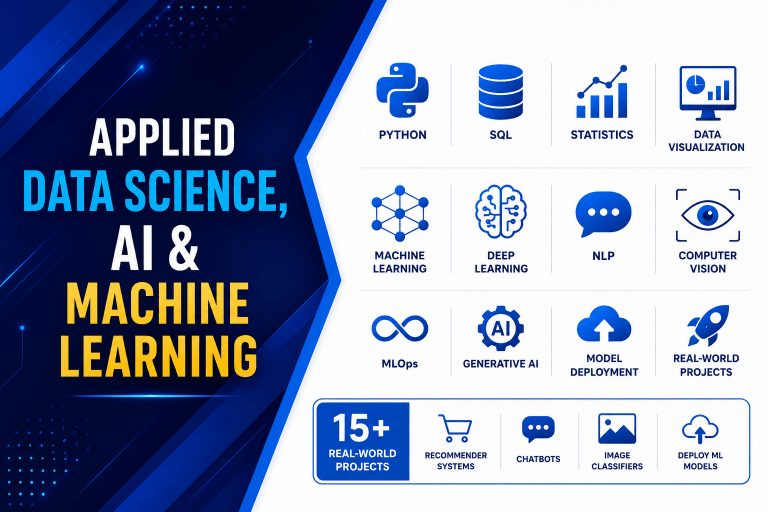
Master data science and AI in 6 months. Learn Python, SQL, statistics, data visualization, machine learning, deep learning, NLP, and Generative AI. Build 8+ projects including recommendation systems, chatbots, and deploy ML models.

Duration: 6 months
Mode: hybrid
Language: Hindi/English
View Curriculum

Curriculum

Module 1: Python Programming for Data Science

3 weeks

Topics Covered:

  • Python Setup (Anaconda, Jupyter Notebook, VS Code, Google Colab)
  • Python Basics (Variables, Data Types, Operators, Type Conversion)
  • Control Flow (if/else, loops, list comprehensions)
  • Functions (Parameters, Return, Lambda, Map, Filter, Reduce)
  • Data Structures (Lists, Tuples, Sets, Dictionaries - Deep Dive)
  • String Manipulation & Regular Expressions
  • File Handling (CSV, JSON, Text Files, Excel)
  • Error Handling (try/except)
  • Object-Oriented Programming Basics
  • Modules & Packages

Projects:

  • Data Processing Automation Script
  • Student Result Analysis System

Module 2: NumPy, Pandas & Data Manipulation

3 weeks

Topics Covered:

  • NumPy Arrays (Creation, Indexing, Slicing, Broadcasting)
  • NumPy Operations (Mathematical, Statistical, Linear Algebra Basics)
  • Pandas Series & DataFrame (Creation, Indexing, Selection)
  • Data Loading (CSV, Excel, JSON, SQL)
  • Data Inspection (head, info, describe, dtypes)
  • Handling Missing Data (isnull, fillna, dropna)
  • Data Cleaning (Duplicates, Outliers, Data Type Conversion)
  • Data Transformation (Apply, Map, GroupBy, Pivot Tables)
  • Merging & Joining DataFrames (concat, merge, join)
  • Time Series Data Handling Basics

Projects:

  • Sales Data Cleaning & Transformation Pipeline
  • Financial Transaction Analysis with Pandas
  • COVID-19 Data Analysis

Module 3: SQL for Data Analysis

2 weeks

Topics Covered:

  • Database Fundamentals & Relational Databases
  • MySQL/PostgreSQL Setup & Basic Commands
  • SQL Basics (SELECT, WHERE, ORDER BY, LIMIT, DISTINCT)
  • Filtering & Logical Operators
  • Aggregate Functions (COUNT, SUM, AVG, MIN, MAX)
  • GROUP BY & HAVING Clauses
  • JOINS Deep Dive (INNER, LEFT, RIGHT, FULL OUTER)
  • Subqueries & CTEs
  • Window Functions (ROW_NUMBER, RANK, LAG, LEAD)
  • Views, Indexes & Query Optimization
  • Connecting Python to SQL (SQLAlchemy)

Projects:

  • E-commerce Sales Analysis with Complex SQL Queries
  • Customer Segmentation with RFM Analysis (SQL)

Module 4: Statistics & Probability for Data Science

2 weeks

Topics Covered:

  • Types of Data (Nominal, Ordinal, Interval, Ratio)
  • Descriptive Statistics (Mean, Median, Mode, Variance, Standard Deviation, IQR)
  • Data Distributions (Normal, Binomial, Poisson)
  • Central Limit Theorem & Sampling Distributions
  • Probability Theory (Conditional Probability, Bayes' Theorem)
  • Inferential Statistics (Confidence Intervals)
  • Hypothesis Testing (p-value, Significance Level, Type I & II Errors)
  • Statistical Tests (T-Test, Chi-Square Test)
  • Correlation vs Causation
  • A/B Testing Basics
  • Statistical Analysis with Python (SciPy)

Projects:

  • A/B Test Analysis for Marketing Campaign
  • Customer Behavior Hypothesis Testing

Module 5: Data Visualization & Storytelling

2 weeks

Topics Covered:

  • Visualization Best Practices
  • Matplotlib Fundamentals (Plots, Subplots, Customization)
  • Seaborn (Distribution Plots, Categorical Plots, Heatmaps, Pair Plots)
  • Plotly & Interactive Visualizations
  • Data Storytelling Framework
  • Dashboard Design Principles
  • Power BI/Tableau Introduction
  • Creating Executive Dashboards & KPI Reports

Projects:

  • Sales Performance Dashboard (Power BI/Tableau)
  • Interactive Data Story (Plotly + Jupyter Notebook)

Module 6: Exploratory Data Analysis (EDA) & Feature Engineering

2 weeks

Topics Covered:

  • EDA Framework & Systematic Approach
  • Univariate, Bivariate & Multivariate Analysis
  • Missing Value Analysis & Imputation Strategies
  • Outlier Detection (Z-Score, IQR)
  • Feature Engineering Techniques:
  • - Encoding Categorical Variables (One-Hot, Label, Ordinal)
  • - Scaling & Normalization (StandardScaler, MinMaxScaler)
  • - Binning & Discretization
  • - Date/Time Feature Extraction
  • - Text Feature Extraction (Bag of Words, TF-IDF)
  • Feature Selection Basics
  • Handling Imbalanced Data (SMOTE)

Projects:

  • Customer Churn EDA & Feature Engineering
  • House Price Prediction - EDA & Feature Engineering

Module 7: Machine Learning - Supervised Learning

4 weeks

Topics Covered:

  • Machine Learning Types & ML Pipeline
  • Train-Test Split & Cross-Validation
  • Bias-Variance Tradeoff & Underfitting/Overfitting
  • Regression Algorithms:
  • - Linear Regression (Simple, Multiple, Assumptions)
  • - Ridge & Lasso Regression (Regularization)
  • - Decision Tree Regression
  • - Random Forest Regression
  • - Gradient Boosting (XGBoost, LightGBM)
  • Classification Algorithms:
  • - Logistic Regression
  • - K-Nearest Neighbors (KNN)
  • - Support Vector Machines (SVM)
  • - Decision Tree Classification
  • - Random Forest Classification
  • - Gradient Boosting (XGBoost, LightGBM)
  • Model Evaluation Metrics:
  • - Regression (MAE, MSE, RMSE, R²)
  • - Classification (Accuracy, Precision, Recall, F1-Score, ROC-AUC)
  • Hyperparameter Tuning (Grid Search, Randomized Search)
  • Ensemble Methods (Bagging, Boosting)
  • Model Interpretation (SHAP, LIME Basics)
  • Scikit-Learn Pipelines

Projects:

  • House Price Prediction Model (Regression)
  • Customer Churn Prediction (Classification)
  • Credit Card Fraud Detection

Module 8: Machine Learning - Unsupervised Learning

2 weeks

Topics Covered:

  • Clustering Algorithms:
  • - K-Means Clustering (Elbow Method, Silhouette Score)
  • - Hierarchical Clustering (Agglomerative)
  • - DBSCAN
  • Dimensionality Reduction:
  • - Principal Component Analysis (PCA)
  • - t-SNE for Visualization
  • Anomaly Detection (Isolation Forest)
  • Association Rule Mining (Apriori Algorithm)
  • Recommendation Systems:
  • - Collaborative Filtering (User-Based, Item-Based)
  • - Content-Based Filtering
  • - Matrix Factorization

Projects:

  • Customer Segmentation using K-Means & RFM
  • Movie Recommendation System
  • Market Basket Analysis

Module 9: Deep Learning with TensorFlow & Keras

3 weeks

Topics Covered:

  • Introduction to Neural Networks & Deep Learning
  • Perceptron, Activation Functions
  • Forward Propagation & Backpropagation
  • Gradient Descent Variants (SGD, Adam)
  • TensorFlow & Keras Setup & Basics
  • Building ANN:
  • - Architecture Design, Compilation, Training
  • - Regularization (Dropout, Batch Normalization, Early Stopping)
  • Convolutional Neural Networks (CNN):
  • - Convolution, Pooling, Flatten
  • - Transfer Learning (Using Pre-trained Models)
  • Recurrent Neural Networks (RNN):
  • - LSTM (Long Short-Term Memory)
  • - GRU (Gated Recurrent Unit)
  • - Time Series Forecasting with LSTM
  • GPU Training with Google Colab

Projects:

  • Image Classification with CNN (CIFAR-10)
  • Transfer Learning for Custom Image Classification
  • Stock Price Prediction using LSTM

Module 10: Natural Language Processing (NLP)

2 weeks

Topics Covered:

  • NLP Fundamentals & Applications
  • Text Preprocessing (Tokenization, Stop Words, Stemming, Lemmatization)
  • Text Vectorization:
  • - Bag of Words (CountVectorizer)
  • - TF-IDF
  • - Word Embeddings (Word2Vec, GloVe)
  • NLP Tasks:
  • - Text Classification (Spam Detection)
  • - Sentiment Analysis (VADER, TextBlob, ML Approaches)
  • - Named Entity Recognition (NER) using spaCy
  • - Topic Modeling (LDA)
  • Transformers & Hugging Face:
  • - Introduction to Transformer Architecture
  • - BERT, GPT Basics
  • - Using Hugging Face Transformers

Projects:

  • Sentiment Analysis of Product Reviews
  • Fake News Detection using NLP
  • Spam Email Classifier

Module 11: Generative AI & Large Language Models (LLMs)

2 weeks

Topics Covered:

  • Introduction to Generative AI
  • How LLMs Work (GPT, Claude, Gemini)
  • Prompt Engineering:
  • - Zero-Shot, Few-Shot, Chain-of-Thought
  • - System Prompts & Role Prompting
  • OpenAI API & GPT Models:
  • - API Setup, Authentication
  • - Chat Completions, Function Calling
  • - Building Applications with GPT API
  • LangChain Framework:
  • - Chains, Agents, Tools
  • - Retrieval Augmented Generation (RAG)
  • - Vector Databases (ChromaDB, Pinecone)
  • Open Source LLMs (Llama 3, Mistral)
  • Running LLMs Locally (Ollama)
  • Hugging Face for LLMs
  • Ethical Considerations & Responsible AI

Projects:

  • AI-Powered Document Q&A System (RAG + LangChain)
  • Customer Support Chatbot using GPT API
  • Content Summarization Tool

Module 12: MLOps, Deployment & Capstone Projects

3 weeks

Topics Covered:

  • MLOps Fundamentals & ML Lifecycle
  • Experiment Tracking (MLflow)
  • Deploying ML Models as APIs:
  • - Flask/FastAPI for Model Serving
  • - Creating REST API Endpoints
  • Containerization with Docker Basics
  • Cloud Deployment:
  • - AWS (EC2, S3)
  • - Google Cloud (Cloud Run)
  • CI/CD Pipelines for ML Basics
  • Streamlit & Gradio for ML Demos
  • Capstone Project:
  • - Problem Definition & Business Context
  • - Data Collection & EDA
  • - Model Selection & Training
  • - Hyperparameter Tuning
  • - API Development & Deployment
  • - Dashboard Creation
  • Career Preparation:
  • - Building Data Science Portfolio
  • - Resume & LinkedIn Optimization
  • - Interview Preparation

Projects:

  • Deploy ML Model as REST API with FastAPI
  • Interactive ML Demo with Streamlit
  • Capstone: End-to-End Customer Churn Prediction System
  • Capstone: AI-Powered Resume Screening System

Learning Objectives

  • Master Python programming with NumPy, Pandas, Matplotlib for data analysis
  • Write complex SQL queries and optimize database performance
  • Apply descriptive and inferential statistics, hypothesis testing
  • Build interactive dashboards using Power BI/Tableau
  • Perform exploratory data analysis (EDA) and feature engineering
  • Implement supervised learning algorithms (Regression, Classification) using Scikit-Learn
  • Implement unsupervised learning (Clustering, PCA)
  • Build deep learning models with TensorFlow/Keras (ANN, CNN, RNN, LSTM)
  • Apply NLP techniques (Text Processing, Sentiment Analysis, Transformers)
  • Work with Generative AI (GPT, LangChain, RAG, Vector Databases)
  • Deploy ML models using Flask/FastAPI and cloud platforms
  • Build an end-to-end data science portfolio with 8+ real-world projects

Why Choose Data Science & AI Bootcamp?

The Data Science & AI Bootcamp is an intensive 6-month program designed to take you from absolute beginner to job-ready data scientist. This accelerated program covers the complete data science lifecycle with a focus on practical, hands-on learning.

  • Complete AI/ML Stack: Python, SQL, Statistics, ML, Deep Learning, NLP, Generative AI, Deployment — everything you need.
  • 8+ Real-World Projects: Build customer churn predictors, recommendation systems, chatbots, and Gen AI applications.
  • Generative AI & LLMs: Dedicated module on GPT, LangChain, RAG, Vector Databases.
  • Industry-Ready Deployment: Learn FastAPI, Docker, cloud deployment.
  • Portfolio Focus: Every module produces a project suitable for your GitHub and resume.
  • Placement Support: Resume building, mock interviews, and job referrals.

Who Should Enroll?

  • Fresh Graduates wanting a high-paying career in data science
  • Working Professionals wanting to switch to data science roles
  • Software Developers wanting to add ML/AI skills
  • Analysts wanting to upgrade to data scientist roles
  • Anyone passionate about AI and its applications

No prior coding experience required! We start from Python basics and build up to advanced AI.

What You'll Build

Data Analysis Projects

  • Sales Data Cleaning Pipeline
  • COVID-19 Time Series Analysis
  • E-commerce SQL Analysis Dashboard

Machine Learning Projects

  • House Price Prediction
  • Customer Churn Prediction
  • Credit Card Fraud Detection
  • Customer Segmentation
  • Movie Recommendation System

Deep Learning Projects

  • Image Classification with CNN
  • Stock Price Prediction with LSTM
  • Transfer Learning for Custom Images

NLP Projects

  • Sentiment Analysis
  • Fake News Detection
  • Spam Email Classifier

Generative AI Projects

  • AI Document Q&A System (RAG + LangChain)
  • Customer Support Chatbot

Capstone Projects (Choose One)

  • End-to-End Customer Churn Prediction System
  • AI-Powered Resume Screening System

Career Opportunities

Entry-Level (₹4-8 LPA)

  • Data Analyst
  • Junior Data Scientist
  • Business Analyst

Mid-Level (₹8-15 LPA)

  • Data Scientist
  • Machine Learning Engineer
  • NLP Engineer

Senior-Level (₹15-30+ LPA)

  • Senior Data Scientist
  • AI/ML Lead

Top Hiring Companies

  • FAANG: Google, Amazon, Microsoft
  • Product: Flipkart, Swiggy, Zomato, Paytm
  • Consulting: Deloitte, EY, KPMG
  • Banks & Finance: JPMC, HDFC, ICICI

Learning Experience

Learning Format

  • Duration: 6 months
  • Mode: Hybrid (Online/Offline)
  • Schedule: 15-20 hours per week
  • 12 modules from Python to Generative AI

Learning Methodology

  • 25% Theory & Concepts
  • 75% Hands-on Coding, Labs & Projects
  • Weekly assignments and coding exercises
  • Capstone projects with mentor evaluation
  • Mock interviews and career preparation

Course Includes

  • Course Material: Notes, code notebooks, datasets, and project templates
  • Cloud Credits: AWS/GCP credits for deployment
  • Assessments: Weekly quizzes and project evaluations
  • Certification: Data Science & AI Bootcamp Certificate
  • Job Support: Resume, LinkedIn, GitHub portfolio, mock interviews
  • Community: Alumni network and peer support

Fee Structure

Course Fee: ₹30,000 (6 months)

Payment Options:

  1. One-time Payment: ₹27,000 (₹3,000 discount)
  2. Quarterly: ₹10,000 × 3
  3. Monthly: ₹5,000 × 6

Frequently Asked Questions

Do I need strong mathematics to start?

No. Required statistics and mathematics are taught step by step with practical context. Module 4 covers everything from basics to advanced statistics needed for ML.

Is this course fast-paced?

Yes, this is an intensive bootcamp designed for 15-20 hours per week. We cover the same content as a 12-month program but in a compressed format with focus on essential topics.

Will I learn Generative AI and LLMs?

Yes! Module 11 is dedicated to Generative AI, covering GPT, LangChain, RAG, Vector Databases, and building AI-powered applications.

Can I get a job after this course?

Yes! With 8+ projects, a deployed capstone, and career preparation module, you'll be well-prepared for Data Analyst, Data Scientist, and ML Engineer roles.

Is deep learning covered?

Yes. Modules 9 covers ANN, CNN, RNN/LSTM, and Transformers with hands-on projects using TensorFlow/Keras.

What if I don't have a powerful laptop?

We use Google Colab and Kaggle Notebooks which provide free GPU access. For deployment, we use cloud platforms with free tiers.

What's the difference between 6-month and 12-month programs?

The 6-month bootcamp is more intensive (15-20 hours/week) and covers essential topics for getting job-ready faster. The 12-month program has more depth, additional modules (Computer Vision, Time Series), and more projects.

What if I fall behind?

We provide recorded lectures, mentor support, and flexible catch-up options. The program is designed for motivated learners who can commit 15-20 hours weekly.

Tags

Data ScienceMachine LearningDeep LearningArtificial IntelligencePythonSQLNLPGenerative AIData Analytics