programData Science & AI/MLbeginnerFeatured

Applied Data Science, AI & Machine Learning

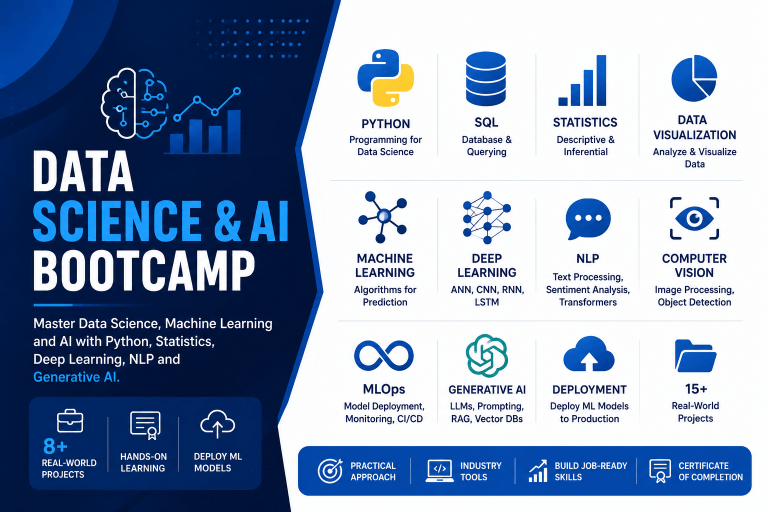
Master data science and AI/ML end-to-end in 12 months. Learn Python, SQL, statistics, data visualization, machine learning, deep learning, NLP, computer vision, MLOps, and Generative AI. Build 15+ projects including recommendation systems, chatbots, image classifiers, and deploy ML models to production.

Duration: 12 months
Mode: hybrid
Language: Hindi/English
View Curriculum

Curriculum

Module 1: Python Programming for Data Science

4 weeks

Topics Covered:

  • Python Setup (Anaconda, Jupyter Notebook, VS Code, Google Colab)
  • Python Basics (Variables, Data Types, Operators, Type Conversion)
  • Control Flow (if/else, loops, list comprehensions)
  • Functions (Parameters, Return, Lambda, Map, Filter, Reduce)
  • Data Structures (Lists, Tuples, Sets, Dictionaries - Deep Dive)
  • String Manipulation & Regular Expressions
  • File Handling (CSV, JSON, Text Files, Excel)
  • Error Handling (try/except, Custom Exceptions)
  • Object-Oriented Programming (Classes, Objects, Inheritance, Polymorphism)
  • Modules & Packages (Import, Create Custom Modules)
  • Python Best Practices & PEP 8 Style Guide
  • Debugging & Profiling Python Code

Projects:

  • Data Processing Automation Script
  • Student Result Analysis System (File Handling)

Module 2: NumPy, Pandas & Data Manipulation

4 weeks

Topics Covered:

  • NumPy Arrays (Creation, Indexing, Slicing, Broadcasting)
  • NumPy Operations (Mathematical, Statistical, Linear Algebra Basics)
  • Vectorized Operations & Performance Comparison
  • Pandas Series & DataFrame (Creation, Indexing, Selection)
  • Data Loading (CSV, Excel, JSON, SQL, Web Scraping Basics)
  • Data Inspection (head, info, describe, dtypes, shape)
  • Handling Missing Data (isnull, fillna, dropna, Interpolation)
  • Data Cleaning (Duplicates, Outliers, Data Type Conversion, String Cleaning)
  • Data Transformation (Apply, Map, GroupBy, Pivot Tables, Melt, Stack/Unstack)
  • Merging & Joining DataFrames (concat, merge, join)
  • Time Series Data Handling (DateTime, Resampling, Rolling Windows)
  • Multi-Indexing & Advanced Pandas Operations
  • Memory Optimization for Large Datasets

Projects:

  • Sales Data Cleaning & Transformation Pipeline
  • Financial Transaction Analysis with Pandas
  • COVID-19 Data Analysis with Time Series

Module 3: SQL for Data Analysis

4 weeks

Topics Covered:

  • Database Fundamentals & Relational Databases
  • MySQL/PostgreSQL Setup & Basic Commands
  • SQL Basics (SELECT, WHERE, ORDER BY, LIMIT, DISTINCT)
  • Filtering & Logical Operators (AND, OR, NOT, IN, BETWEEN, LIKE, IS NULL)
  • Aggregate Functions (COUNT, SUM, AVG, MIN, MAX)
  • GROUP BY & HAVING Clauses
  • JOINS Deep Dive (INNER, LEFT, RIGHT, FULL OUTER, CROSS, SELF)
  • Subqueries (Scalar, Row, Table, Correlated, EXISTS)
  • Window Functions (ROW_NUMBER, RANK, DENSE_RANK, LAG, LEAD, NTILE, Running Totals, Moving Averages)
  • Common Table Expressions (CTEs) & Recursive CTEs
  • Views, Indexes & Query Optimization (EXPLAIN, Execution Plans)
  • Data Cleaning with SQL
  • Advanced SQL (CASE Statements, UNION, INTERSECT, EXCEPT)
  • Connecting Python to SQL (SQLAlchemy, pandas.read_sql)
  • Database Design & Normalization Basics

Projects:

  • E-commerce Sales Analysis with Complex SQL Queries
  • Customer Segmentation with RFM Analysis (SQL)
  • Employee Attrition Analysis Dashboard (SQL + Python)

Module 4: Statistics & Probability for Data Science

4 weeks

Topics Covered:

  • Types of Data (Nominal, Ordinal, Interval, Ratio)
  • Descriptive Statistics (Mean, Median, Mode, Range, Variance, Standard Deviation, IQR)
  • Percentiles, Quartiles & Five-Number Summary
  • Skewness & Kurtosis (Distribution Shapes)
  • Data Distributions (Normal, Binomial, Poisson, Exponential, Uniform)
  • Central Limit Theorem & Sampling Distributions
  • Probability Theory (Conditional Probability, Bayes' Theorem)
  • Inferential Statistics (Confidence Intervals, Margin of Error)
  • Hypothesis Testing (Null/Alternative Hypothesis, p-value, Significance Level, Type I & II Errors)
  • Statistical Tests (Z-Test, T-Test (One Sample, Two Sample, Paired), Chi-Square Test, ANOVA)
  • Correlation (Pearson, Spearman) vs Causation
  • A/B Testing (Design, Sample Size Calculation, Statistical Significance, Practical Significance)
  • Effect Size & Statistical Power
  • Bootstrap & Permutation Tests
  • Statistical Analysis with Python (SciPy, Statsmodels)

Projects:

  • A/B Test Analysis for Marketing Campaign (Statistical Report)
  • Customer Behavior Hypothesis Testing
  • Medical Trial Data Analysis (T-Test, Chi-Square)

Module 5: Data Visualization & Storytelling

3 weeks

Topics Covered:

  • Visualization Best Practices (Chart Selection, Color Theory, Avoiding Misleading Visuals)
  • Matplotlib Fundamentals (Figures, Axes, Plots, Subplots, Customization)
  • Seaborn (Distribution Plots, Categorical Plots, Relational Plots, Heatmaps, Pair Plots)
  • Plotly & Interactive Visualizations (Line, Bar, Scatter, Bubble, Choropleth Maps)
  • Geospatial Visualization (Folium, GeoPandas)
  • Data Storytelling Framework (Context, Narrative, Insights, Recommendations)
  • Dashboard Design Principles
  • Power BI Introduction (Data Import, Visualizations, DAX Basics, Dashboards)
  • Tableau Introduction (Worksheets, Dashboards, Stories)
  • Creating Executive Dashboards & KPI Reports
  • Visualization for Specific Domains (Finance, Marketing, Healthcare, Operations)

Projects:

  • Sales Performance Dashboard (Power BI / Tableau)
  • Interactive Data Story (Plotly + Jupyter Notebook)
  • Executive KPI Dashboard with Multiple Data Sources

Module 6: Exploratory Data Analysis (EDA) & Feature Engineering

3 weeks

Topics Covered:

  • EDA Framework & Systematic Approach
  • Univariate Analysis (Distribution, Central Tendency, Spread, Outliers)
  • Bivariate Analysis (Scatter Plots, Correlation Matrix, Cross-Tabulations, Group Comparisons)
  • Multivariate Analysis (Pair Plots, PCA Visualization, Parallel Coordinates)
  • Missing Value Analysis (MCAR, MAR, MNAR, Imputation Strategies)
  • Outlier Detection (Z-Score, IQR, Isolation Forest, DBSCAN)
  • Feature Engineering Techniques:
  • - Encoding Categorical Variables (One-Hot, Label, Ordinal, Target, Frequency, Binary)
  • - Scaling & Normalization (StandardScaler, MinMaxScaler, RobustScaler, Log Transform)
  • - Binning & Discretization
  • - Date/Time Feature Extraction
  • - Text Feature Extraction (Bag of Words, TF-IDF Introduction)
  • - Polynomial Features & Interaction Terms
  • Feature Selection (Filter Methods, Wrapper Methods, Embedded Methods, Feature Importance)
  • Handling Imbalanced Data (SMOTE, ADASYN, Class Weights)
  • Automated EDA Tools (Pandas Profiling, Sweetviz, AutoViz)

Projects:

  • Customer Churn EDA & Feature Engineering (Telecom Dataset)
  • House Price Prediction - EDA & Feature Engineering
  • Credit Risk Analysis - Complete EDA Report

Module 7: Machine Learning - Supervised Learning

6 weeks

Topics Covered:

  • Machine Learning Types (Supervised, Unsupervised, Reinforcement)
  • ML Pipeline (Data → Preprocessing → Model → Evaluation → Deployment)
  • Train-Test Split & Cross-Validation (K-Fold, Stratified K-Fold, Time Series Split)
  • Bias-Variance Tradeoff & Underfitting/Overfitting
  • Regression Algorithms:
  • - Linear Regression (Simple, Multiple, Assumptions, Residual Analysis)
  • - Ridge Regression (L2 Regularization)
  • - Lasso Regression (L1 Regularization, Feature Selection)
  • - ElasticNet Regression
  • - Polynomial Regression
  • - Decision Tree Regression
  • - Random Forest Regression
  • - Gradient Boosting Regression (XGBoost, LightGBM, CatBoost)
  • Classification Algorithms:
  • - Logistic Regression (Binary & Multiclass, Decision Boundary)
  • - K-Nearest Neighbors (KNN)
  • - Naive Bayes (Gaussian, Multinomial, Bernoulli)
  • - Support Vector Machines (SVM, Kernel Trick, C Parameter)
  • - Decision Tree Classification (Gini, Entropy, Pruning)
  • - Random Forest Classification (Ensemble, Feature Importance)
  • - Gradient Boosting (XGBoost, LightGBM, CatBoost)
  • Model Evaluation Metrics:
  • - Regression (MAE, MSE, RMSE, R², Adjusted R², MAPE)
  • - Classification (Accuracy, Precision, Recall, F1-Score, ROC-AUC, PR-AUC, Confusion Matrix, Classification Report)
  • Hyperparameter Tuning (Grid Search, Randomized Search, Bayesian Optimization, Optuna)
  • Ensemble Methods (Bagging, Boosting, Stacking, Voting Classifier)
  • Model Interpretation (SHAP, LIME, Partial Dependence Plots, Feature Importance)
  • Scikit-Learn Pipelines for Production

Projects:

  • House Price Prediction Model (Regression)
  • Customer Churn Prediction (Classification)
  • Credit Card Fraud Detection (Imbalanced Classification)
  • Employee Salary Prediction with Hyperparameter Tuning

Module 8: Machine Learning - Unsupervised Learning

3 weeks

Topics Covered:

  • Clustering Algorithms:
  • - K-Means Clustering (Elbow Method, Silhouette Score, K-Means++)
  • - Hierarchical Clustering (Agglomerative, Dendrograms)
  • - DBSCAN (Density-Based, Noise Points, Epsilon & Min Samples)
  • - Gaussian Mixture Models (GMM)
  • Dimensionality Reduction:
  • - Principal Component Analysis (PCA) (Explained Variance, Scree Plot, Components)
  • - t-SNE (t-Distributed Stochastic Neighbor Embedding) for Visualization
  • - UMAP Introduction
  • - SVD & Truncated SVD
  • Anomaly Detection (Isolation Forest, One-Class SVM, LOF, Autoencoders)
  • Association Rule Mining (Apriori Algorithm, Market Basket Analysis)
  • Recommendation Systems:
  • - Collaborative Filtering (User-Based, Item-Based)
  • - Content-Based Filtering
  • - Matrix Factorization (SVD for Recommendations)
  • - Hybrid Recommendation Systems
  • Clustering Evaluation (Silhouette, Davies-Bouldin, Calinski-Harabasz)

Projects:

  • Customer Segmentation using K-Means & RFM Analysis
  • Movie Recommendation System (Collaborative Filtering)
  • Market Basket Analysis for Retail Store
  • Anomaly Detection in Network Traffic

Module 9: Deep Learning with TensorFlow & Keras

5 weeks

Topics Covered:

  • Introduction to Neural Networks & Deep Learning
  • Perceptron, Activation Functions (Sigmoid, Tanh, ReLU, LeakyReLU, Softmax)
  • Forward Propagation & Backpropagation
  • Gradient Descent Variants (SGD, Momentum, Adam, RMSprop, Adagrad)
  • TensorFlow & Keras Setup & Basics
  • Building Artificial Neural Networks (ANN):
  • - Architecture Design (Input, Hidden, Output Layers, Neurons)
  • - Compilation (Loss Functions, Optimizers, Metrics)
  • - Training (Epochs, Batch Size, Validation Split, Callbacks)
  • - Regularization (Dropout, Batch Normalization, Early Stopping)
  • - Model Evaluation & Hyperparameter Tuning
  • Convolutional Neural Networks (CNN):
  • - Convolution, Pooling, Flatten, Fully Connected Layers
  • - Popular Architectures (LeNet, AlexNet, VGG, ResNet, Inception)
  • - Transfer Learning (Using Pre-trained Models, Fine-Tuning)
  • - Image Classification & Object Detection Basics
  • Recurrent Neural Networks (RNN):
  • - Simple RNN & Vanishing Gradient Problem
  • - LSTM (Long Short-Term Memory)
  • - GRU (Gated Recurrent Unit)
  • - Bidirectional RNN/LSTM
  • - Time Series Forecasting with LSTM
  • Model Saving & Loading (HDF5, SavedModel, TensorFlow Serving)
  • GPU Training with Google Colab/Kaggle

Projects:

  • Image Classification with CNN (CIFAR-10/Fashion MNIST)
  • Transfer Learning for Custom Image Classification
  • Stock Price Prediction using LSTM
  • Sentiment Analysis with ANN on IMDB Dataset

Module 10: Natural Language Processing (NLP)

4 weeks

Topics Covered:

  • NLP Fundamentals & Applications
  • Text Preprocessing (Tokenization, Stop Words, Stemming, Lemmatization, Lowercasing, Punctuation Removal)
  • Text Vectorization:
  • - Bag of Words (CountVectorizer)
  • - TF-IDF (Term Frequency-Inverse Document Frequency)
  • - Word Embeddings (Word2Vec, GloVe, FastText)
  • - Contextual Embeddings Introduction (BERT, GPT)
  • NLP Tasks:
  • - Text Classification (Spam Detection, News Categorization)
  • - Sentiment Analysis (VADER, TextBlob, ML & DL Approaches)
  • - Named Entity Recognition (NER) using spaCy
  • - Part-of-Speech (POS) Tagging
  • - Topic Modeling (LDA - Latent Dirichlet Allocation)
  • - Text Summarization (Extractive & Abstractive)
  • - Text Generation Basics
  • spaCy Library Deep Dive (Pipeline, Tokens, Entities, Dependency Parsing)
  • NLTK Library Overview
  • Transformers & Hugging Face:
  • - Introduction to Transformer Architecture (Attention Mechanism)
  • - BERT (Bidirectional Encoder Representations from Transformers)
  • - GPT Family (Generative Pre-trained Transformer)
  • - Using Hugging Face Transformers (Pipelines, Fine-Tuning)
  • - Pre-trained Models for Various Tasks

Projects:

  • Sentiment Analysis of Product Reviews
  • Fake News Detection using TF-IDF & ML/DL
  • Spam Email Classifier with Deployment
  • Text Summarization Application (Hugging Face)
  • Chatbot using Intent Classification (Rule-Based + ML)

Module 11: Computer Vision

3 weeks

Topics Covered:

  • Introduction to Computer Vision & Applications
  • Image Processing Basics (OpenCV, PIL/Pillow)
  • Image Operations (Read, Write, Resize, Crop, Rotate, Color Spaces)
  • Filters & Edge Detection (Sobel, Canny, Gaussian Blur)
  • Image Augmentation (Rotation, Flip, Zoom, Brightness, Contrast - Albumentations)
  • Object Detection:
  • - YOLO (You Only Look Once) Family (YOLOv5/YOLOv8)
  • - R-CNN, Fast R-CNN, Faster R-CNN
  • - SSD (Single Shot Detector)
  • Image Segmentation:
  • - Semantic Segmentation
  • - Instance Segmentation (Mask R-CNN)
  • - U-Net for Biomedical Images
  • Face Detection & Recognition (Haar Cascades, Dlib, FaceNet)
  • Optical Character Recognition (OCR) (Tesseract, EasyOCR)
  • GANs (Generative Adversarial Networks) Introduction
  • Image Generation with Stable Diffusion Introduction
  • Video Analysis Basics

Projects:

  • Object Detection System using YOLO
  • Face Recognition Attendance System
  • OCR for Document Digitization
  • Image Classification with Custom CNN + Transfer Learning

Module 12: Generative AI & Large Language Models (LLMs)

4 weeks

Topics Covered:

  • Introduction to Generative AI & Its Impact
  • How Large Language Models Work (GPT, Claude, Gemini, Llama)
  • Prompt Engineering:
  • - Prompt Design Patterns (Zero-Shot, Few-Shot, Chain-of-Thought, Tree of Thoughts)
  • - System Prompts & Role Prompting
  • - Prompt Optimization & Iterative Refinement
  • - Handling Hallucinations & Bias
  • OpenAI API & GPT Models (GPT-4, GPT-4o):
  • - API Setup, Authentication, Pricing
  • - Chat Completions, Function Calling, JSON Mode
  • - Building Applications with GPT API
  • LangChain Framework:
  • - Chains, Agents, Tools, Memory
  • - Document Loaders & Text Splitters
  • - Retrieval Augmented Generation (RAG)
  • - Vector Databases (ChromaDB, Pinecone, Weaviate)
  • - Building Q&A Systems over Documents
  • Open Source LLMs (Llama 3, Mistral, Gemma)
  • Running LLMs Locally (Ollama, LM Studio)
  • Fine-Tuning LLMs (LoRA, QLoRA Basics)
  • Hugging Face for LLMs (Model Hub, Inference API)
  • AI Agents & Multi-Agent Systems Introduction
  • Ethical Considerations & Responsible AI
  • AI Safety & Alignment

Projects:

  • AI-Powered Document Q&A System (RAG with LangChain)
  • Customer Support Chatbot using GPT API + Vector Database
  • Content Summarization & Generation Tool
  • Multi-Document Research Assistant with RAG

Module 13: MLOps, Deployment & Cloud for ML

3 weeks

Topics Covered:

  • MLOps Fundamentals & ML Lifecycle Management
  • Experiment Tracking (MLflow, Weights & Biases)
  • Model Versioning & Registry
  • Deploying ML Models as APIs:
  • - Flask/FastAPI for Model Serving
  • - Creating REST API Endpoints for Predictions
  • - Request Validation & Error Handling
  • - API Documentation (Swagger/OpenAPI)
  • Containerization with Docker:
  • - Dockerfile, Images, Containers
  • - Docker Compose for Multi-Container Apps
  • - Containerizing ML Applications
  • Cloud Deployment:
  • - AWS (SageMaker, EC2, Lambda, S3)
  • - Google Cloud (Vertex AI, Cloud Run)
  • - Azure (Azure ML, App Service)
  • CI/CD Pipelines for ML (GitHub Actions, Model Testing, Automated Deployment)
  • Model Monitoring (Data Drift, Concept Drift, Performance Monitoring)
  • Feature Stores Introduction
  • Streamlit & Gradio for ML Demos & Quick UIs
  • Scaling ML Applications (Load Balancing, Caching, Batch vs Real-Time)

Projects:

  • Deploy ML Model as REST API with FastAPI + Docker
  • Build Interactive ML Demo with Streamlit
  • CI/CD Pipeline for ML Model Training & Deployment
  • Model Monitoring Dashboard with Evidently AI

Module 14: Time Series Analysis & Forecasting

3 weeks

Topics Covered:

  • Time Series Components (Trend, Seasonality, Cyclicity, Noise)
  • Stationarity & Differencing (ADF Test, KPSS Test)
  • Moving Averages & Exponential Smoothing (Simple, Double, Triple/Holt-Winters)
  • ARIMA Models (AR, MA, ARMA, ARIMA, SARIMA)
  • Auto ARIMA & Automated Forecasting
  • Prophet by Facebook (Trend, Seasonality, Holidays, Changepoints)
  • Deep Learning for Time Series (LSTM, GRU, CNN-LSTM)
  • Multivariate Time Series Forecasting
  • Time Series Cross-Validation
  • Evaluation Metrics (MAE, RMSE, MAPE, SMAPE)
  • Anomaly Detection in Time Series

Projects:

  • Sales Forecasting for Retail Store (ARIMA vs Prophet vs LSTM)
  • Stock Price Prediction & Analysis
  • Website Traffic Forecasting
  • Energy Consumption Prediction

Module 15: Capstone Projects

5 weeks

Topics Covered:

  • Problem Statement Definition & Business Context
  • Data Collection & Integration from Multiple Sources
  • Comprehensive EDA & Feature Engineering
  • Model Selection, Training & Hyperparameter Tuning
  • Model Evaluation & Interpretation
  • API Development & Deployment
  • Dashboard Creation & Insights Presentation
  • Project Documentation & Code Repository
  • Final Presentation to Industry Mentors

Projects:

  • Capstone 1: End-to-End Customer Churn Prediction System (ML + Deployment + Dashboard)
  • Capstone 2: AI-Powered Resume Screening & Job Matching System (NLP + ML)
  • Capstone 3: Real-Time Sentiment Analysis Dashboard (NLP + Deep Learning + Streamlit)
  • Capstone 4: E-commerce Product Recommendation Engine (Collaborative + Content-Based + Deployment)
  • Capstone 5: Medical Image Classification & Diagnosis Assistant (CNN + Transfer Learning + API)

Module 16: Career Preparation & Industry Readiness

2 weeks

Topics Covered:

  • Building Data Science Portfolio (GitHub, Kaggle, Personal Website)
  • Creating ATS-Friendly Data Science Resume
  • LinkedIn Profile Optimization for Data Roles
  • Writing Effective Data Science Case Studies
  • Kaggle Competitions Strategy & Profile Building
  • Job Search Strategy (Naukri, LinkedIn, Wellfound, Instahyre, Cutshort)
  • Interview Preparation:
  • - SQL & Python Coding Questions
  • - Statistics & Probability Questions
  • - Machine Learning Theory & Case Studies
  • - Product Case Studies & Business Problems
  • - Behavioral & HR Questions
  • Mock Technical Interviews (3 Rounds with Feedback)
  • Salary Negotiation Tips
  • Freelancing & Consulting in Data Science
  • Staying Updated (Research Papers, Blogs, Newsletters, Conferences)
  • Further Learning Paths (ML Engineering, Research Scientist, AI Product Manager)

Projects:

  • Professional Data Science Portfolio Website
  • Kaggle Profile with 3+ Competition Submissions
  • GitHub Repository with All Projects & READMEs

Learning Objectives

  • Master Python programming with NumPy, Pandas, Matplotlib, Seaborn for data analysis
  • Write complex SQL queries, window functions, and optimize database performance
  • Apply descriptive and inferential statistics, hypothesis testing, and A/B testing
  • Build interactive dashboards using Power BI/Tableau and Python visualization libraries
  • Perform exploratory data analysis (EDA) and feature engineering on real-world datasets
  • Implement supervised learning algorithms (Regression, Classification) using Scikit-Learn
  • Implement unsupervised learning (Clustering, PCA, Anomaly Detection)
  • Build deep learning models with TensorFlow/Keras (ANN, CNN, RNN, LSTM)
  • Apply NLP techniques (Text Processing, Sentiment Analysis, Transformers, LLMs)
  • Build computer vision applications (Image Classification, Object Detection, Segmentation)
  • Deploy ML models using Flask/FastAPI, Docker, and cloud platforms (AWS/GCP/Azure)
  • Understand MLOps, model monitoring, and CI/CD pipelines for ML
  • Work with Generative AI (GPT, Stable Diffusion, LangChain, RAG, Vector Databases)
  • Build an end-to-end data science portfolio with 15+ real-world projects

Why Choose Applied Data Science, AI & Machine Learning?

The Applied Data Science, AI & Machine Learning program is a comprehensive 12-month journey that takes you from absolute beginner to industry-ready data scientist and ML engineer. This program covers the complete data science lifecycle with cutting-edge AI technologies.

  • Complete AI/ML Stack: Python, SQL, Statistics, ML, Deep Learning, NLP, Computer Vision, Generative AI, MLOps — everything you need.
  • 15+ Real-World Projects: Build customer churn predictors, recommendation systems, chatbots, image classifiers, and Gen AI applications.
  • Generative AI & LLMs: Dedicated module on GPT, LangChain, RAG, Vector Databases, and building AI-powered applications.
  • Industry-Ready MLOps: Learn Docker, FastAPI, cloud deployment (AWS/GCP/Azure), CI/CD, and model monitoring.
  • Portfolio Focus: Every module produces a project suitable for your GitHub and resume.
  • Placement Support: Resume building, mock interviews, Kaggle profile, and job referrals.

Who Should Enroll?

  • Fresh Graduates (Any Stream - BTech, BCA, BSc, BCom, BA) wanting a high-paying career in data science
  • Working Professionals wanting to switch to data science/AI roles
  • Software Developers wanting to add ML/AI skills
  • Analysts wanting to upgrade to data scientist roles
  • Business Professionals wanting data-driven decision-making skills
  • Anyone passionate about AI and its applications

No prior coding experience required! We start from Python basics and build up to advanced AI.

What You'll Build

Data Analysis Projects

  • Sales Data Cleaning Pipeline (Pandas)
  • COVID-19 Time Series Analysis
  • E-commerce SQL Analysis Dashboard
  • Customer Churn EDA & Feature Engineering
  • Marketing A/B Test Analysis

Machine Learning Projects

  • House Price Prediction (Regression)
  • Customer Churn Prediction (Classification)
  • Credit Card Fraud Detection
  • Customer Segmentation (Clustering)
  • Movie Recommendation System

Deep Learning Projects

  • Image Classification with CNN
  • Stock Price Prediction with LSTM
  • Sentiment Analysis with ANN
  • Transfer Learning for Custom Images

NLP & Computer Vision Projects

  • Fake News Detection (NLP)
  • Spam Email Classifier
  • Object Detection with YOLO
  • Face Recognition System
  • OCR Document Digitization

Generative AI Projects

  • AI Document Q&A System (RAG + LangChain)
  • Customer Support Chatbot (GPT + Vector DB)
  • Multi-Document Research Assistant

MLOps Projects

  • ML Model Deployment with FastAPI + Docker
  • Interactive ML Demo with Streamlit
  • CI/CD Pipeline for ML

Capstone Projects (Choose One)

  • End-to-End Customer Churn Prediction System
  • AI-Powered Resume Screening System
  • Real-Time Sentiment Analysis Dashboard
  • E-commerce Product Recommendation Engine
  • Medical Image Classification Assistant

Career Opportunities

Entry-Level (₹4-8 LPA)

  • Data Analyst
  • Junior Data Scientist
  • Business Analyst
  • ML Associate

Mid-Level (₹8-18 LPA)

  • Data Scientist
  • Machine Learning Engineer
  • NLP Engineer
  • Computer Vision Engineer
  • MLOps Engineer

Senior-Level (₹18-40+ LPA)

  • Senior Data Scientist
  • AI/ML Lead
  • Research Scientist
  • AI Product Manager

Top Hiring Companies

  • FAANG: Google, Amazon, Microsoft, Meta, Apple
  • Product: Flipkart, Swiggy, Zomato, Ola, Paytm, PhonePe
  • AI Startups: OpenAI, Anthropic, Cohere, Stability AI
  • Consulting: Deloitte, EY, KPMG, BCG, McKinsey
  • Banks & Finance: JPMC, Goldman Sachs, HDFC, ICICI
  • Healthcare & Pharma

Learning Experience

Learning Format

  • Duration: 12 months
  • Mode: Hybrid (Online/Offline)
  • Schedule: 10-12 hours per week
  • 16 modules from Python to Generative AI

Learning Methodology

  • 25% Theory & Concepts
  • 75% Hands-on Coding, Labs & Projects
  • Weekly assignments and coding exercises
  • Kaggle competitions and hackathons
  • Capstone projects with industry mentor evaluation
  • Mock interviews and career preparation

Course Includes

  • Course Material: Notes, code notebooks, datasets, and project templates
  • Cloud Credits: AWS/GCP credits for deployment practice
  • Kaggle Mentorship: Competition strategy and profile building
  • Assessments: Weekly quizzes, coding challenges, and project evaluations
  • Certification: Applied Data Science, AI & ML Certificate
  • Job Support: Resume, LinkedIn, GitHub portfolio, mock interviews, referrals
  • Community: Lifetime alumni network and peer support

Fee Structure

Course Fee: ₹45,000 (12 months)

Payment Options:

  1. One-time Payment: ₹40,000 (₹5,000 discount)
  2. Half-yearly: ₹22,500 × 2
  3. Quarterly: ₹11,250 × 4
  4. Monthly: ₹3,750 × 12

Frequently Asked Questions

Do I need strong mathematics to start?

No. Required statistics and mathematics are taught step by step with practical context. Module 4 covers everything from basics to advanced statistics needed for ML.

Which programming language is used?

Python is the primary language. SQL is also covered extensively. All modern data science and AI/ML work is Python-based.

Will I learn Generative AI and LLMs?

Yes! Module 12 is entirely dedicated to Generative AI, covering GPT, LangChain, RAG, Vector Databases, prompt engineering, and building AI-powered applications.

Can I get a job after this course?

Yes! With 15+ projects, a deployed capstone, Kaggle profile, and career preparation module, you'll be well-prepared for Data Analyst, Data Scientist, and ML Engineer roles.

Is deep learning covered in depth?

Yes. Modules 9, 10, and 11 cover ANN, CNN, RNN/LSTM, Transformers, NLP, and Computer Vision with hands-on projects using TensorFlow/Keras.

What if I don't have a powerful laptop for deep learning?

We use Google Colab and Kaggle Notebooks which provide free GPU access. For deployment, we use cloud platforms with free tiers.

How is this different from other data science courses?

This program covers Generative AI (the latest trend), MLOps (model deployment), and has dedicated project modules. It's not just theory — you build production-ready applications and deploy them.

Tags

Data ScienceMachine LearningDeep LearningArtificial IntelligencePythonSQLNLPComputer VisionMLOpsGenerative AIData Analytics